The ShowMo MileFlask: Long-Range Camera with no Cell Service Needed
No WiFi in the pasture. No cell signal in the barn. No monthly fees. No problem.
The Problem
If you've ever wanted to put a camera in your barn, on your pasture fence line, or at the end of your driveway, you've probably run into the same wall I did. WiFi doesn't reach that far. Cellular cameras work (if you have service) but come with monthly data plans that never stop. Trail cameras take pictures but don't give you live video, and you have to walk out and pull the SD card to see anything.
I was running three Reolink cellular cameras at Howdy Hills before this. They worked. The image quality was great. 4K, pan-tilt-zoom, the whole package. But I was paying about $115 per camera per year in data plans. That's $345 a year just to keep three cameras connected. It's not a fortune, but it's the kind of recurring cost that bugs you every time you think about it because it never goes away.
When I found out about the ShowMo MileFlask, a long-range camera system with no monthly fees, I wanted to see if it could replace my Reolinks. I signed up for their Kickstarter, and followed their progress. Late last year they solicited beta testers for their cameras, and I volunteered. ShowMo provided a kit for me to test on the farm, and I've been running it for a little while now. Here's what I've found.
Disclosure: ShowMo provided this MileFlask kit for testing. I was prepared to buy one, and still plan on buying additional cameras. Links in this post are referral links, and I may earn a commission if you purchase through them. All opinions are my own.
What the MileFlask Actually Is
The MileFlask is a wireless camera system that uses a technology called Wi-Fi HaLow instead of regular WiFi or cellular. Wi-Fi HaLow operates on the 900 MHz band, which is a lower frequency than standard WiFi. Lower frequency means longer range and better ability to penetrate obstacles like trees, walls, and terrain. The manufacturer claims up to a mile of range, and they say they've tested it at over two miles in open air.
The system has two parts. A base station plugs into your home router with an ethernet cable. That's your bridge to the internet. The cameras connect wirelessly to the base station over the 900 MHz signal. The cameras are solar powered with a battery backup, so you don't run any wires to them at all. You mount them, point the solar panel at the sun, and they stay charged. The kit comes with an antenna to mount outside your home in case you need it for the extended ranges. I played with it and it seemed high quality, and like it had everything necessary for mounting. I thought I'd need it, but after putting my cameras up, they talked to the base station with no problems. If you have to use the extended antenna, it looks like you'll need 120v power where you mount the included junction box, and then an ethernet cable would run into your home.
I'm currently using my base station over WiFi, and not running into any issues. There's also the ability to directly connect with ethernet.
Each camera shoots 2K resolution (2304x1296) with a 130-degree field of view, color night vision, and two-way audio. Storage is built into the system with 256 GB of onboard eMMC storage. No SD cards to manage, no mandatory cloud subscription. One base station supports up to eight cameras. The app is called ShowMo, available on iOS and Android, and there's a web portal at portal.showmo365.com for monitoring from a computer. There is a subscription available that gets you cloud backups, but I haven't seen a need for that. Right now that plan starts at $1.99 per month.
My Setup at Howdy Hills
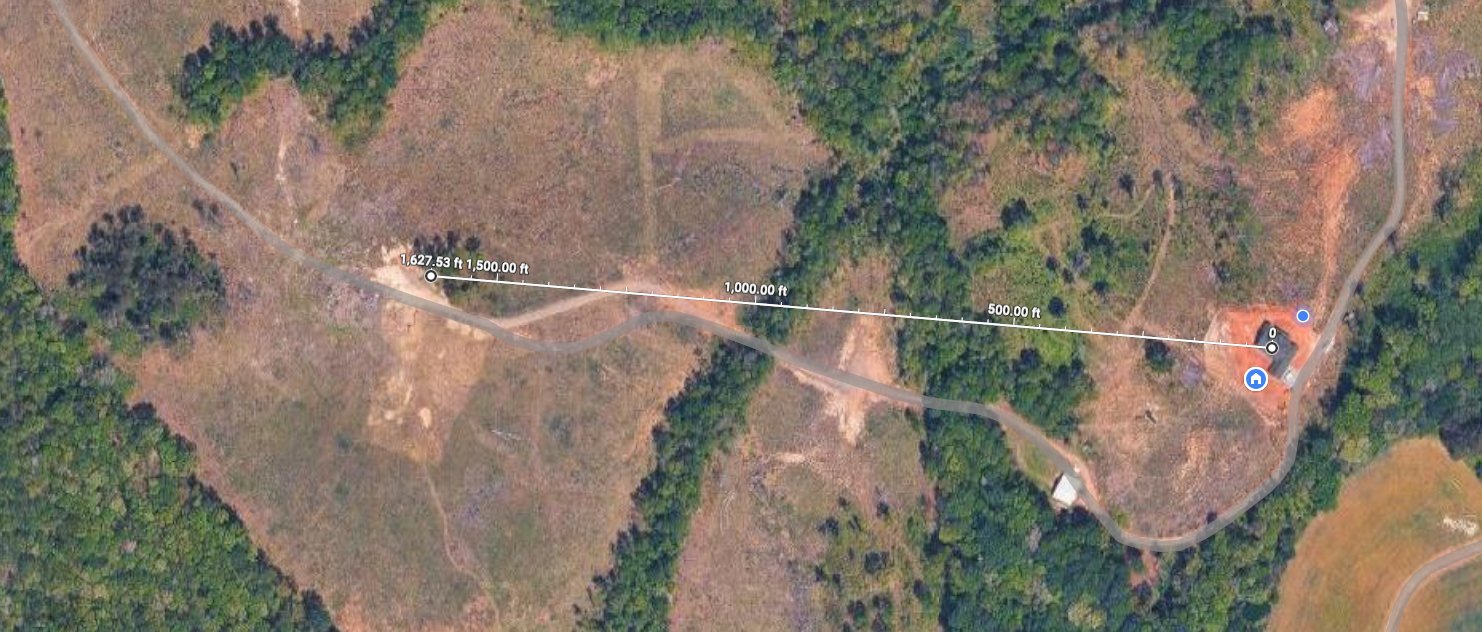
I'm running two cameras on our 120+ acre property in Virginia. Camera one is pointed at the driveway, farmstand, and entrance area. It's a little over 1,000 feet from my house. Camera two is pointed at the pasture fence line, about a third of a mile from the base station. The base station is also in the middle of my house in a media closet that houses my router and all my ethernet leads coming back from my cameras mounted on my house.
The farmstand camera is nice, because it's a dead spot for cell signal, and I couldn't get my Reolink cameras to work there. Now I have a camera that talks back to my house, and I can check from anywhere.
 Fun fact: that tree you see down in the frame fell during a recent windstorm and barely missed the farmstand. I wish I'd had the camera then to catch it!
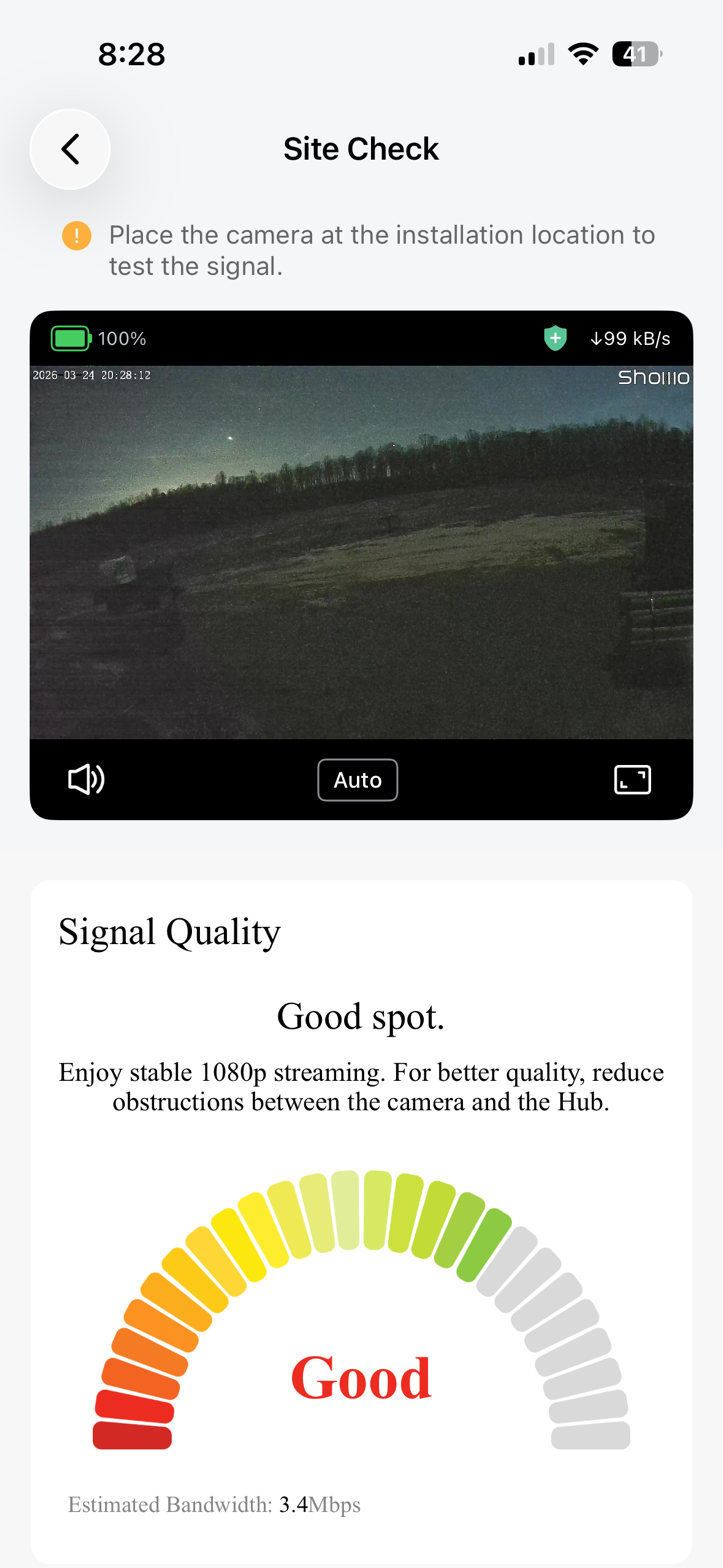
That second camera is the real test for distance, though. The signal between it and the base station passes through two sets of dense hardwoods, and crosses two hills with elevation changes. This is not a flat, open-field scenario. It's real terrain with real obstacles, and the kind of setup that would be completely impossible with standard WiFi.
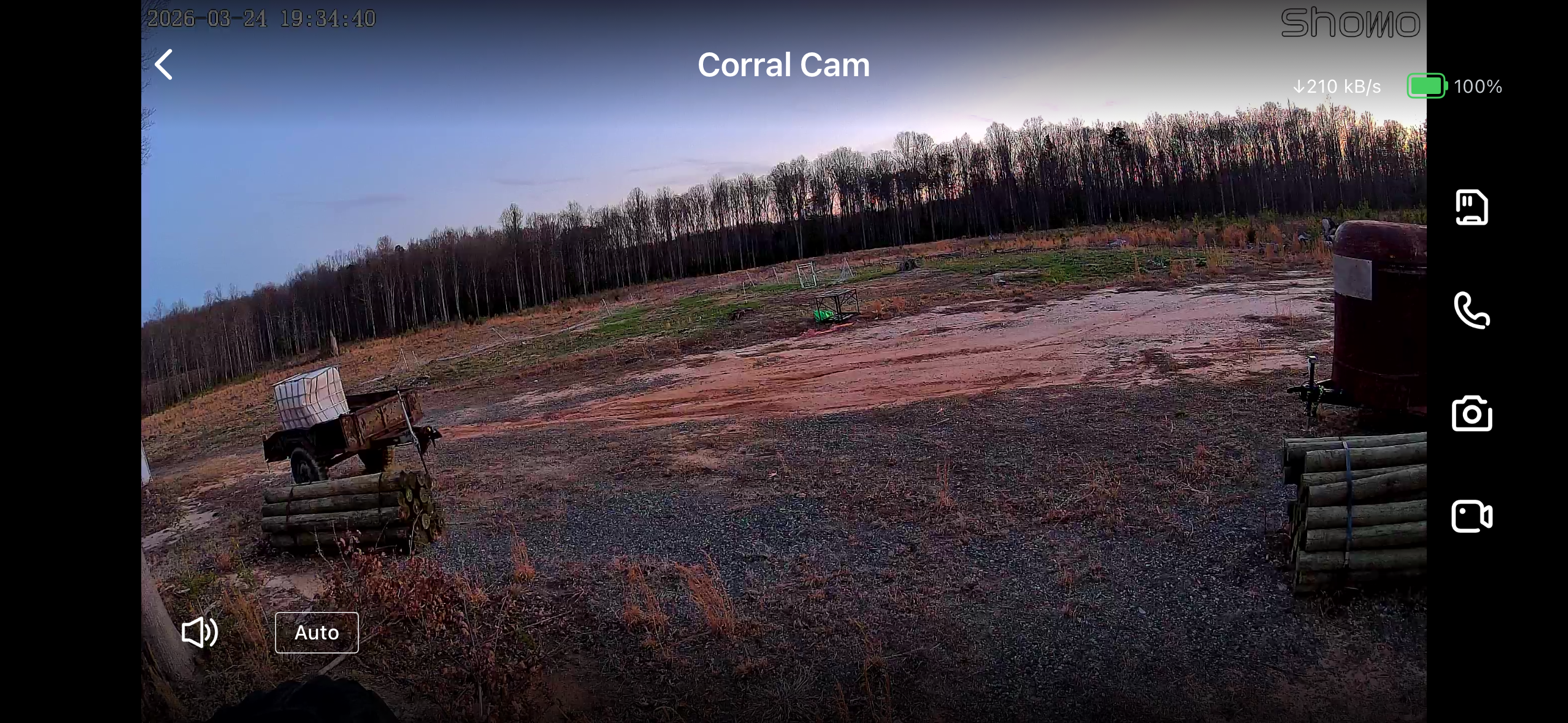
I was skeptical about the range claims going in, and the performance through trees and hills is what surprised me the most. I just plugged it in, and it worked. No need to mount the external antenna or troubleshoot anything.
How It's Going
Right now I have no complaints with the cameras. They haven't missed a single event of vehicles in the driveway, and as far as I know they haven't missed any people or animals either. They've picked up me walking, and my dog when she's with me. I was also able to fine tune the detection zone so that cars driving past on the road don't trigger it. The solar has left the cameras at 100% battery each afternoon, and even the farmstand camera with several detections per day looks like it would last a few days of absolutely no sun.
I will say that communication from ShowMo was weak initially. I was selected as a beta tester quickly, and was supposed to receive the cameras in January. I reached out after the shipping date was supposed to have passed, and did not receive any feedback until the kit had actually shipped. I think the kits got caught in customs, but a quick email back letting me know there would be a delay would have been nice. Since then all of my emails have been returned within 24 hours, and they have been very receptive to feedback.
The included screws and straps for the cameras and solar panels were lacking. They only included two straps with four devices to mount. The straps also weren't long enough for any of the trees I selected. I feel like they're meant for light pole sized trees. I also used better screws than they provided. Theirs were meant to be used with plastic anchors and predrilling. I wasn't sure that would hold up to the wind here on the solar panels, so I used some longer deck screws.
One small thing worth mentioning. The solar panel that ships with the camo camera is white. If you're going with the camo version specifically because you want something discreet, a bright white solar panel next to it kind of defeats the purpose. It's not an issue for me, but if blending in is important to you, you'd want to paint it or find a cover.
What I Gained by Switching
The obvious one is no more monthly fees. That $345 a year in Reolink data plans is gone. Over three years, three Reolinks would cost me about $1,605 when you add up hardware and data. The MileFlask camo kit with two cameras and the base station lists for $660, one time. That's $945 in savings over three years. By year five, the gap is over $1,600. The kit prices and individual camera prices I've gotten from ShowMo look like they'll be $150 for the white cameras and $165 for the camo ones. The more cameras that are bought here the faster the savings scale.
The cold weather battery preheating system is a feature I haven't fully tested yet since we're coming into spring, but it's designed to allow the solar panel to charge the battery in freezing temperatures. That matters for anyone who wants to use these during calving season in January or February. I know from my solar setup, that with the lithium batteries, heating is critical for battery life.
What I Gave Up
I want to be honest about this because every product review that only talks about the good stuff is useless.
I lost pan-tilt-zoom. The Reolinks had PTZ, which meant I could remotely aim the camera to follow an animal or scan a wider area. The MileFlask cameras are fixed position. You point them where you want them and that's what you see. For a pasture overview that's fine. For tracking a specific animal across a field, you'd need to be more deliberate about camera placement or add more cameras.
I went from 4K to 2K resolution. The Reolinks shot in 4K, which gave me more detail at distance. The MileFlask is 2K, which is still good, but at long range you notice the difference. This is a trade-off of the Wi-Fi HaLow technology. The 900 MHz signal has a bandwidth of about 2 Mbps, which is enough for 2K but not 4K. That's the price of the range.
There currently isn't a timelapse feature. I loved this when building our house, and Reolink gave me a great timelapse of the entire build process. I have asked them to add this, and they have it with their product team.
I went from three cameras to two. This is a budget and kit-size thing, not a limitation of the system. You can run up to eight cameras per base station. Right now they're fulfilling preorders, though, and told me additional cameras would be available in June.
And I gave up cellular independence. My Reolinks worked anywhere there was cell signal. The MileFlask cameras need to be within range of the base station, and the base station needs to be connected to your home internet. If your internet goes down, your cameras go down. If you need cameras at a location with no internet at all, cellular is still the only option.
Reolink has also been around for a while. There's lots out there about how to use them and they have a more complete ecosystem if you're looking to keep everything on the same app.
Does It Play Nice with Other Systems?
This is where it gets interesting for the tech-oriented crowd.
I'm building a Raspberry Pi 5-based farm operations center at Howdy Hills. This is a centralized monitoring system that pulls in solar/battery data from my SunGoldPower inverter, geothermal HVAC data from a WaterFurnace Symphony system, and security camera feeds into a unified Grafana dashboard. My Reolink PoE cameras (mounted on my house) connect to Frigate NVR (an open-source AI-powered video recorder) running on the Pi for person/vehicle/animal detection.
The question was whether the MileFlask cameras could join that unified system, or whether they'd be stuck in a separate app.
The answer: yes, they can integrate. I confirmed with ShowMo that the MileHub supports ONVIF, which is the industry standard protocol for IP camera interoperability. This means you can connect MileFlask cameras to third-party NVR systems, NAS devices, and software like Frigate, Blue Iris, or Synology Surveillance Station.
They noted that compatibility may vary depending on the ONVIF implementation of the third-party system, which is a fair caveat. ONVIF implementations aren't always perfectly standardized. I'll be testing the Frigate integration once I have the ONVIF setup documentation and will update this post with results.
They're also planning integration with Matter 1.5, which would enable broader smart home platform compatibility (Home Assistant, Apple Home, Google Home, etc.).
For a camera at this price point and with this kind of range, having ONVIF support is a big deal. Most consumer wireless cameras in this category are app-only.
Who This Is For
If you have a barn, a coop, a pasture gate, or any part of your property that's out of WiFi range and you want to keep an eye on it without paying monthly fees forever, this is worth looking at. It's especially relevant for livestock monitoring, security on rural properties, or just being able to check on things from your phone without walking out to the back forty.
If you need 4K resolution for identifying details at extreme distance, or you need PTZ to follow animals across a wide area, or you need cameras at a location with no home internet anywhere nearby, one of the cellular options might be a better fit.
The Bottom Line
I went into this hoping it would work and expecting to find deal-breaking limitations. The range claim felt like marketing. It wasn't. The MileFlask does what it says, and the 900 MHz signal through hardwoods and across two hills is genuinely impressive.
It's not perfect. The 2K resolution and lack of PTZ are real trade-offs compared to what I was getting from my Reolinks. But when I look at what I'm not paying every month and what I'm getting in return, the math works. The MileFlask earned its spot on the farm.
You can find the MileFlask at showmo365.com. You can use the code howdyag for 10% off.
Like what you're reading?
Get farm management tips, genetics deep dives, and product updates delivered to your inbox. No spam.